Many Orlando trips are split trips. A family flies down for four or five days, spends a day or two at Universal, and the rest at Disney, or the other way around. The split is common.
The planning tools are not built for that. Most of them cover one park, or one resort, and the other half of your trip lives somewhere else. So you plan the trip multiple times: once in the Disney tool, once in the Universal tool, and the flights, the hotel, and the transfers live in additional places that know nothing about each other. The trip is one trip.
The awkward case
Single-park tools are good at their one park. The problem is the seams. Your Universal day ends and your Disney day begins, and nothing connects them. The hotel night between them belongs to neither plan. The dining reservation on the Disney day sits in an app that has never heard of your Universal tickets. You are the only connection between the two halves, which means you are re-explaining the trip to your own family every day.
A split trip also has the most moving parts. Two sets of tickets, possibly two hotels, a transfer between parks or resorts, and a different rhythm each day: Universal days run on Express Pass timing, Disney days run on Lightning Lane timing and dining windows. The more parts, the more the plan needs one home.
One itinerary, both parks
The fix is the same as for any scattered trip: one place that holds all of it. Flights, hotel, transfers, dining, and every park day in one itinerary, with live and predicted wait times for both Universal and Disney sitting within the days they belong to. One share link for the whole family, one printed PDF, and a change made in one place that shows up everywhere.
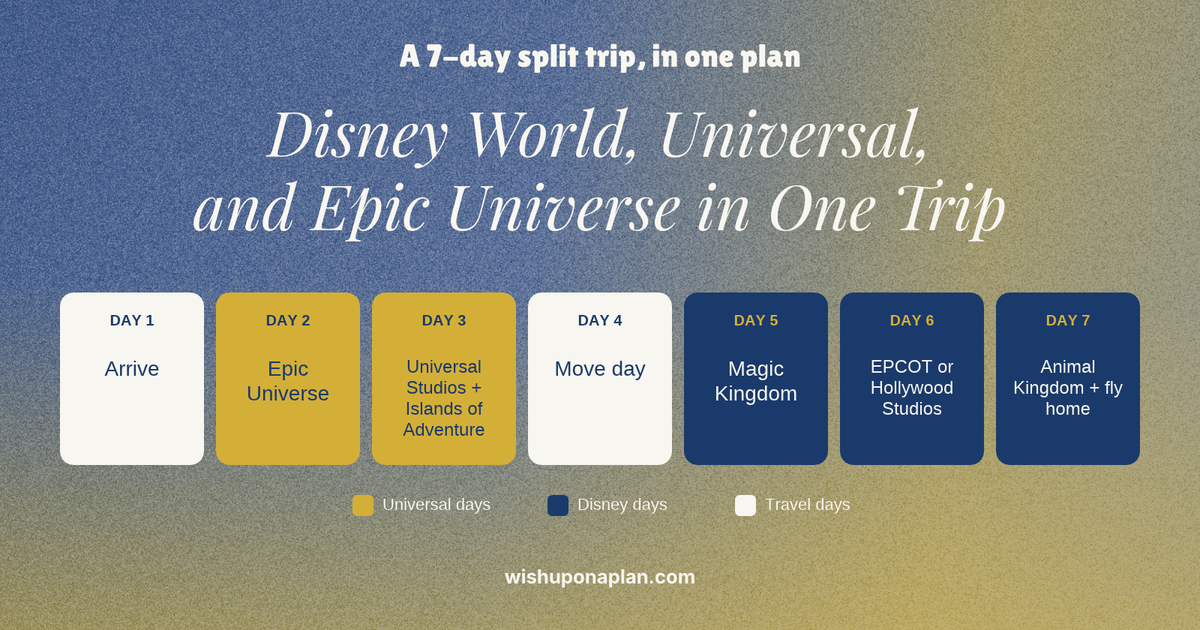
Here is what a sample split week looks like in one plan:
Day 1, arrival. Flight lands, transfer to the hotel, one easy evening. No park. The plan holds the flight, the transfer, and the hotel confirmation, so the arrival day is accounted for instead of improvised.
Day 2, Universal. Islands of Adventure and Universal Studios in one day, or one park done properly. The plan holds the park(s) of the day, the must-dos, and the predicted wait times, so the day is ordered by what is actually busy, not by guesswork.
Day 3, Disney. A full Disney park day, with dining attached to the day it happens and the wait times in view while you order the day. The same plan, the same link, no second app.
Day 4, Disney and departure. A morning in the parks, an early afternoon second park if the morning goes well, then the flight home. The plan holds the departure flight next to the last park hours, so the day ends on time instead of in a rush.
Nothing in that week is exotic. It is a normal family trip. The only unusual thing is that all of it lives in one place, which is what makes it feel calm instead of scattered.
Why it matters more than it sounds
Two plans do not just double the work. They double the places a mistake can hide. A dining time that conflicts with a park close, a transfer booked for the wrong hotel night, a ticket day used on the wrong day: these are the errors that live in the gap between two plans, and they only show up when it is too late to fix them. One plan shows the conflict while it is still fixable.
It also changes who carries the trip. With one share link, everyone sees the same current plan: the partner, the grandparents, the teenager who will not read a group chat. Nobody has to ask you what is happening, because the plan on their phone is the plan.
I am filming a split Disney and Universal weekend in December and will show how the plan held up, day by day. Until then, the short version is this: if your trip has two parks in it, plan it in one place. The trip is already one trip. Let the plan be one plan too.
Start a free trial with your own next split trip and see whether one plan feels different from two.